


Trump Accounts are a new type of tax-deferred traditional individual retirement account created for children under Section 530A of the Internal Revenue Code. A child with a valid Social Security number who has not turned 18 before the end of the election year may have an account established. Eligible children born from January 1, 2025, through December 31, 2028, may also receive a one-time $1,000 contribution from the U.S. Treasury if the required election is made.
The account is designed primarily for long-term investing, but it is not necessarily the best or only savings vehicle for every family. Parents and grandparents may still need a 529 plan for education, a custodial Roth IRA for a working child, or an UGMA or UTMA account for flexible gifts. The right approach depends on what the money is intended to accomplish, when it may be needed, and how much control the family wants to retain.
Trump Accounts at a glance
- The child does not need earned income for contributions to be made during the growth period.
- Personal and employer contributions are generally subject to a combined $5,000 annual limit in 2026; certain government, charitable, pilot, and rollover contributions are excluded from that limit.
- An employer may contribute up to $2,500 under a qualifying program without the amount being included in the employee's taxable income; the employer contribution counts toward the $5,000 general limit.
- Investments are limited to qualifying low-cost mutual funds or ETFs that track an index of primarily U.S. companies.
- Withdrawals are generally unavailable during the growth period, which ends January 1 of the calendar year in which the child turns 18.
What Is a Trump Account?
A Trump Account is owned by the child and begins as a special type of traditional IRA. During the account's growth period, contributions can be made even when the child has no wages or other taxable compensation. According to current IRS guidance, contributions could not begin before July 4, 2026, and the account is subject to special rules until the beginning of the calendar year in which the beneficiary turns 18.
The program has drawn significant early interest. As of June 2026, Treasury reported that nearly six million Trump Accounts had been opened or elected, including approximately 1.4 million children eligible for the $1,000 pilot contribution. Because participation figures and administrative guidance may continue to change, families should confirm the latest information before acting.
Who Qualifies for the $1,000 Government Contribution?
The eligibility rules for opening a Trump Account are broader than the rules for receiving the pilot contribution. To receive the one-time $1,000 Treasury contribution, the child generally must:
- Have been born in 2025, 2026, 2027, or 2028.
- Be a U.S. citizen.
- Have a valid Social Security number.
- Have an eligible individual, typically a parent or guardian, make the required election for the account and pilot contribution.
- Not already have a pilot-program election processed on the child's behalf.
The election can be made using IRS Form 4547 through an IRS Individual Online Account or through the applicable tax-filing process.
How Trump Account Contributions Work in 2026
During the growth period, a Trump Account may receive money from parents, relatives, friends, employers, certain governments, and qualifying charitable organizations. The contribution rules differ depending on the source:
- Personal and employer contributions. These are generally subject to a combined annual limit of $5,000 in 2026. The limit is scheduled to be adjusted for inflation after 2027.
- Employer contributions. A qualifying employer program may contribute up to $2,500 for an employee or an employee's dependent without the contribution being included in the employee's taxable income. This amount counts toward the $5,000 general limit.
- Pilot and qualified general contributions. The $1,000 pilot contribution and certain qualifying contributions from governments or nonprofit organizations generally do not count toward the $5,000 annual limit.
- Earned income. Unlike a custodial Roth IRA, the child does not need earned income for contributions to be made during the Trump Account growth period.
Families should keep records of contribution sources because the future tax treatment of distributions can depend on whether contributions created tax basis in the account.
How the Money Can Be Invested
Investment choices are intentionally limited during the growth period. The account generally must use a mutual fund or exchange-traded fund that tracks an index of primarily U.S. companies, does not use leverage, and meets statutory cost and diversification requirements. This keeps the account focused on simple, broad-market investing, but it also means families cannot use the full range of investments that may be available in a traditional brokerage or custodial Roth IRA.
When Can Money Be Withdrawn?
The account is designed to remain invested for many years. During the growth period, distributions are generally prohibited except for limited circumstances such as an eligible rollover, an eligible ABLE account rollover at age 17, correction of excess contributions, or the beneficiary's death.
Beginning January 1 of the calendar year in which the beneficiary turns 18, the account is generally treated as a traditional IRA. Withdrawals may be taxable and may also face the 10% additional tax on early distributions unless an IRA exception applies. For example, qualified higher-education expenses or a qualifying first-home purchase may avoid the additional 10% tax, but that does not necessarily make the withdrawal income-tax-free.
Why Starting Early Can Matter
The greatest potential advantage of a child-focused investment account is time. Compound growth occurs when investment returns are earned on both the original contribution and prior gains. The longer the investment period, the more meaningful that compounding can become, although actual returns will vary and investments can lose value.
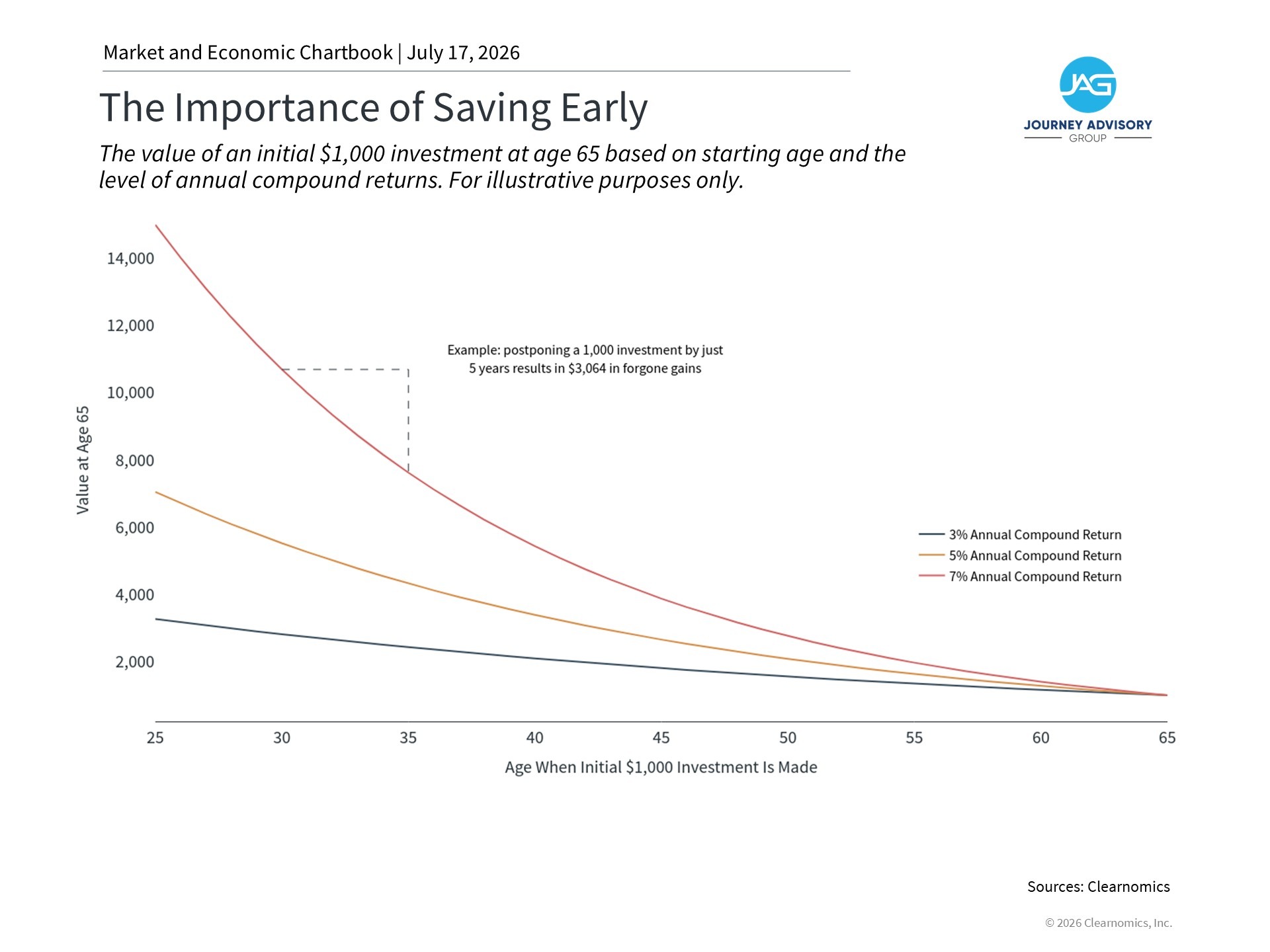
The chart illustrates why even a modest contribution made earlier may have more potential to grow than a larger contribution made much later. It is not a projection of any Trump Account, and the account's actual outcome will depend on contributions, investment performance, expenses, taxes, and future law.
Trump Account vs. 529 Plan, Custodial Roth IRA, and UGMA/UTMA
Each account solves a different planning problem. A Trump Account is primarily a long-term retirement vehicle. A 529 plan is built around education. A custodial Roth IRA can be powerful for a child with earned income. An UGMA or UTMA account offers flexibility, but the assets irrevocably belong to the child.
Feature | Trump Account | 529 Plan | Custodial Roth IRA | UGMA/UTMA |
|---|---|---|---|---|
Primary purpose | Long-term retirement investing for a child | Qualified education expenses | Retirement investing for a child with earned income | Flexible gifting and investing for a minor |
Earned income required? | No | No | Yes | No |
2026 contribution framework | Generally a $5,000 combined annual limit for personal and employer contributions; certain contributions are excluded | No single federal annual cap, but state aggregate limits and federal gift-tax rules apply | Up to the child’s taxable compensation or $7,500, whichever is less | No account-specific federal annual cap; gift-tax rules apply |
Tax treatment | Federally tax-deferred growth; state treatment may differ. Future tax treatment also depends on contribution source and withdrawal rules | Tax-free growth and qualified withdrawals for eligible education expenses | After-tax contributions; qualified withdrawals can be tax-free | Taxable investment income; kiddie-tax rules may apply |
Access and control | Generally restricted during the growth period; the child owns the account | The account owner generally controls withdrawal timing and beneficiary changes | The child owns the account; Roth IRA withdrawal rules apply | A custodian manages the account until the state’s termination age, after which the child controls it |
Investment choices | Limited to qualifying low-cost U.S. index funds or ETFs during the growth period | Plan investment menu | Broad investment choices, depending on the custodian | Broad investment choices, depending on the custodian |
Financial-aid consideration | New account type; monitor future federal-aid guidance | A parent-owned 529 is generally reported as a parent asset for a dependent student | Retirement-account treatment differs from ordinary assets; confirm current rules before withdrawals | Generally reported as the student’s asset on the FAFSA |
May be a fit when… | The goal is very long-term investing and the family accepts limited access | Education is a primary goal and the family wants owner control | The child has legitimate earned income and retirement flexibility is valuable | The family wants broad-use assets and accepts that the gift is irrevocable |
Comparison is general and may not reflect every tax, state-law, financial-aid, or plan-specific rule. Confirm current guidance before making a contribution or withdrawal.
How Different Accounts Can Work Together
For many families, the question is not whether one account is universally better. It is how multiple accounts can be assigned different jobs within the family's broader plan.
- Use a 529 plan for education-specific dollars. A 529 plan may be the clearest fit when the family expects the money to be used for qualified education expenses and wants the account owner to retain control. Under current rules, unused 529 assets may also have limited rollover opportunities to a Roth IRA when statutory requirements are met, although that strategy has its own restrictions.
- Use a custodial Roth IRA when the child has earned income. A child with legitimate wages or self-employment income may contribute up to the lesser of taxable compensation or the 2026 IRA limit of $7,500. Families should document the income and follow payroll, tax-filing, and contribution rules carefully.
- Use an UGMA or UTMA account when flexibility matters more than control. These accounts can hold investments for broad purposes, but the transfer is generally irrevocable and the child gains control at the age established by state law. Investment income may be affected by the kiddie tax, and the account is generally treated as a student asset for FAFSA purposes.
- Use a Trump Account for dollars intended to remain invested for the long term. The account may be attractive when the family wants retirement-oriented compounding, the child has no earned income, and the family is comfortable with restricted access and limited investment choices during the growth period.
Planning Opportunities and Cautions for Parents and Grandparents
Coordinate Education and Retirement Goals
A child may have both a Trump Account and a 529 plan. Keeping the goals separate can make the plan easier to manage: education dollars can remain available for school, while retirement-oriented dollars can stay invested for a longer horizon. Before directing too much to a restricted account, families should also protect their own emergency reserves and retirement plan.
Understand the 529 Five-Year Gift-Tax Election
The federal annual gift-tax exclusion is $19,000 per recipient in 2026. A donor may contribute as much as $95,000 to a 529 plan and elect to treat the contribution as made ratably over five years for federal gift-tax purposes. The election generally requires filing Form 709, and additional gifts to the same beneficiary during the five-year period can affect the calculation. This technique should be coordinated with a tax professional.
Do Not Assume a UTMA Transfer Produces a Lower Tax Rate
Gifting appreciated investments to an UGMA or UTMA account can create unintended consequences. The child generally receives the donor's cost basis, investment income may be taxed under the kiddie-tax rules, and the transfer cannot usually be taken back. The strategy should be evaluated based on the asset, basis, tax exposure, financial-aid implications, and the age when the child will gain control.
Review Beneficiary Designations and Estate-Planning Documents
A child's account is only one part of family planning. Parents should also review wills, guardianship provisions, beneficiary designations, life insurance, powers of attorney, and the people who would manage assets if a parent dies or becomes incapacitated. A strong plan coordinates the account with the family's broader estate and cash-flow decisions.
Long-Term Investing Still Involves Risk
A long time horizon can help an investor recover from short-term market declines, but it does not eliminate risk. Broad U.S. stocks have historically produced substantial long-term growth, while also experiencing wars, recessions, bubbles, financial crises, and periods of high inflation. Families should expect volatility and avoid treating historical results as a promise of future returns.
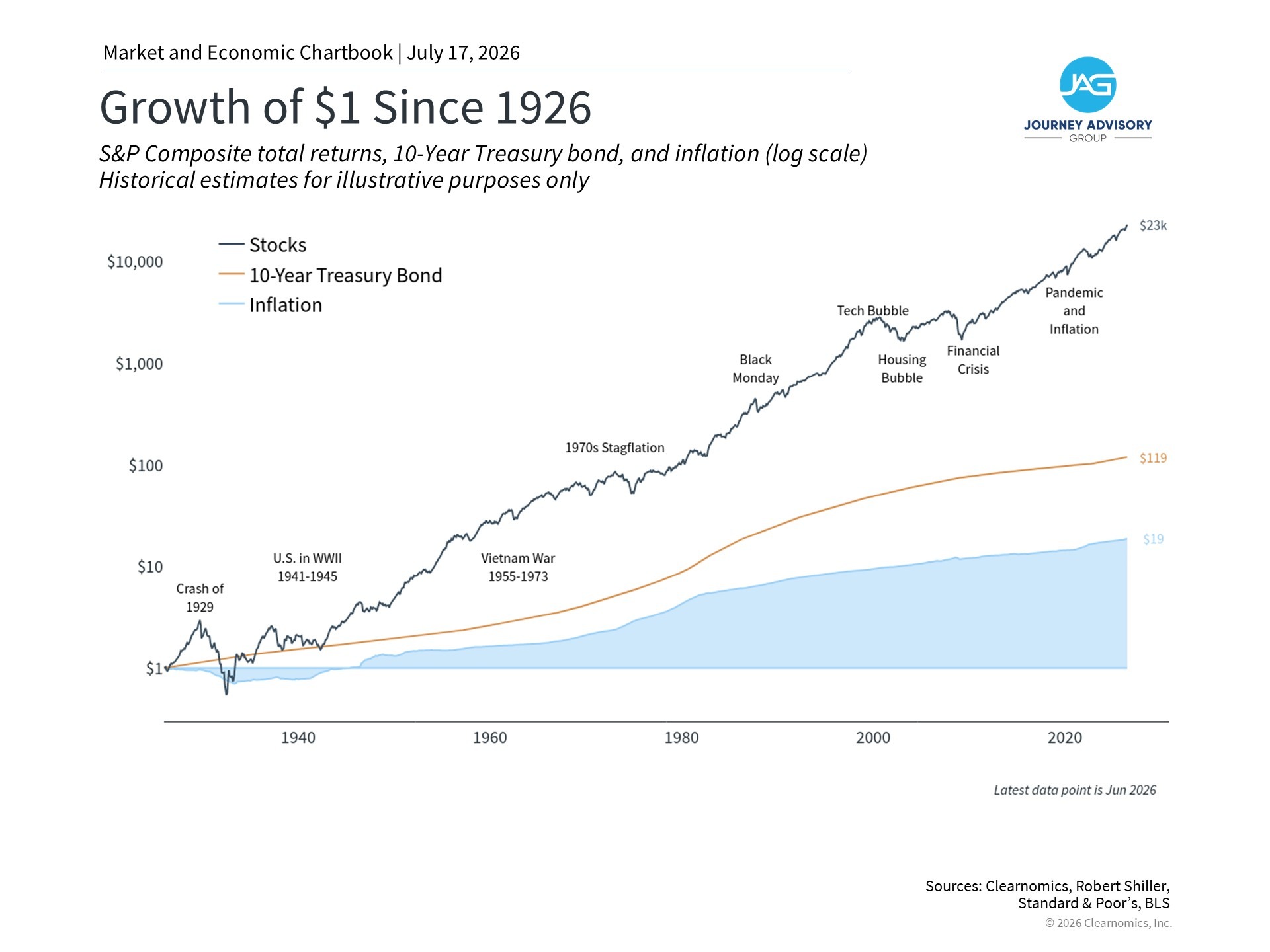
The chart is a reminder that long-term growth has not occurred in a straight line. The appropriate account and investment strategy should reflect the family's objective, time horizon, ability to tolerate losses, liquidity needs, and overall financial plan.
Frequently Asked Questions About Trump Accounts
Are All Children Eligible for the $1,000 Contribution?
No. The pilot contribution generally applies to U.S. citizens with valid Social Security numbers who were born in 2025 through 2028 and for whom the required election is made. A child who does not qualify for the pilot may still be eligible to have a Trump Account established if the general account requirements are met.
Does a Child Need a Job or Earned Income?
No. Contributions may be made during the growth period even if the child has no taxable compensation. That is one of the primary differences between a Trump Account and a custodial Roth IRA.
Can Grandparents Contribute to a Trump Account?
Generally, yes. Parents, grandparents, relatives, friends, and other individuals may contribute, subject to the account's annual limit and applicable gift-tax rules. The account must first be properly established.
Are There State Tax Considerations for Trump Accounts?
Yes. Although Trump Accounts receive tax-deferred treatment for federal income tax purposes, the same treatment may not apply in every state. Depending on the state tax rules that apply, account earnings may be subject to state income tax before the money is withdrawn. Employer contributions and certain qualified general contributions may also receive different treatment at the state level.
As of July 2026, California, Hawaii, Kentucky, Massachusetts, Pennsylvania, South Carolina, and Wisconsin had indicated that annual Trump Account earnings would be taxable under existing state law. Because state conformity rules may change, families should confirm current guidance with a qualified tax professional before contributing to or taking distributions from an account.
Can a Trump Account Be Used to Pay for College?
The money generally cannot be withdrawn during the growth period. Beginning January 1 of the calendar year in which the beneficiary turns 18, traditional IRA rules generally apply. A qualified higher-education withdrawal may avoid the 10% additional tax, but the taxable portion of the distribution may still be subject to ordinary income tax.
Are Trump Account Contributions Tax Deductible?
Personal contributions are generally made with after-tax dollars and are not treated like a deductible traditional IRA contribution. A qualifying employer contribution of up to $2,500 may be excluded from the employee's taxable income, subject to the program rules and the overall annual limit.
Is a Trump Account Better Than a 529 Plan?
Neither account is universally better. A 529 plan is usually more directly aligned with education and gives the account owner greater control. A Trump Account is more restrictive and is designed for long-term retirement-oriented investing. Families may use both for different goals.
Can a Child Have Both a Trump Account and a Custodial Roth IRA?
Yes, provided the child and the accounts satisfy the applicable rules. A custodial Roth IRA requires earned income and has its own annual contribution limit. Families should coordinate contributions with the child's income, tax reporting, and long-term goals.
How Is a Trump Account Opened?
An authorized individual generally makes an election using Form 4547. The IRS allows eligible taxpayers to submit the election through an IRS Individual Online Account or through the applicable tax-return process. Families should use current IRS instructions because administrative procedures may change.
Coordinate Your Family's Education, Retirement, and Legacy Planning
Saving for a child can involve more than selecting one account. Journey Advisory Group helps families in Cincinnati, Northern Kentucky, Dayton, and beyond coordinate education funding, long-term investing, tax-aware gifting, and estate-planning considerations through one connected financial plan.
Sources
- Internal Revenue Service: Trump Accounts
- Instructions for Form 4547, Trump Account Election(s)
- IRS guidance on Trump Accounts established under the Working Families Tax Cuts
- U.S. Treasury statement on Trump Account participation, June 3, 2026
- IRS: 2026 IRA contribution limits
- IRS: 529 plans, questions and answers
- Investor.gov: An Introduction to 529 Plans
- Federal Student Aid: Current net worth of investments, including UGMA and UTMA accounts
- IRS: 2026 tax inflation adjustments, including the annual gift-tax exclusion
- Clearnomics research and chartbook graphics dated July 17, 2026; historical market data through June 2026
- The Washington Post: State tax treatment of Trump Accounts, based on responses from state tax agencies
Index Description
S&P 500. The Standard & Poor's 500 Index is a capitalization-weighted index of 500 stocks designed to measure performance of the broad domestic economy through changes in the aggregate market value of 500 stocks representing all major industries. The modern design of the S&P 500 stock index was first launched in 1957. Performance prior to 1957 incorporates the performance of the predecessor index, the S&P 90.
Important Disclosures
This material prepared by Journey Advisory Group is for informational purposes only. It is not intended to serve as a substitute for personalized investment, tax, or legal advice or as a recommendation or solicitation of any particular security, strategy, or investment product. Tax laws, account rules, and financial-aid policies can change. Journey Advisory Group does not provide tax preparation or legal services. Consult the appropriate professional regarding your circumstances. Economies and markets fluctuate. Facts presented have been obtained from sources believed to be reliable. Journey Advisory Group, however, cannot guarantee the accuracy or completeness of such information, and certain information may have been condensed or summarized from its original source. Past performance is not an indicator of future results.
Copyright © 2026 Clearnomics, Inc. All rights reserved. The information contained herein has been obtained from sources believed to be reliable, but is not necessarily complete and its accuracy cannot be guaranteed. No representation or warranty, express or implied, is made as to the fairness, accuracy, completeness, or correctness of the information and opinions contained herein. The views and the other information provided are subject to change without notice. All reports posted on or via www.clearnomics.com or any affiliated websites, applications, or services are issued without regard to the specific investment objectives, financial situation, or particular needs of any specific recipient and are not to be construed as a solicitation or an offer to buy or sell any securities or related financial instruments. Past performance is not necessarily a guide to future results. Company fundamentals and earnings may be mentioned occasionally, but should not be construed as a recommendation to buy, sell, or hold the company's stock. Predictions, forecasts, and estimates for any and all markets should not be construed as recommendations to buy, sell, or hold any security, including mutual funds, futures contracts, exchange-traded funds, or any similar instruments. The text, images, and other materials contained or displayed in this report are proprietary to Clearnomics, Inc. and constitute valuable intellectual property. All unauthorized reproduction or other use of material from Clearnomics, Inc. shall be deemed willful infringement(s) of this copyright and other proprietary and intellectual property rights, including but not limited to rights of privacy. Clearnomics, Inc. expressly reserves all rights in connection with its intellectual property, including without limitation the right to block the transfer of its products and services and/or to track usage thereof through electronic tracking technology, and all other lawful means, now known or hereafter devised. Clearnomics, Inc. reserves the right, without further notice, to pursue to the fullest extent allowed by law any and all criminal and civil remedies for the violation of its rights.