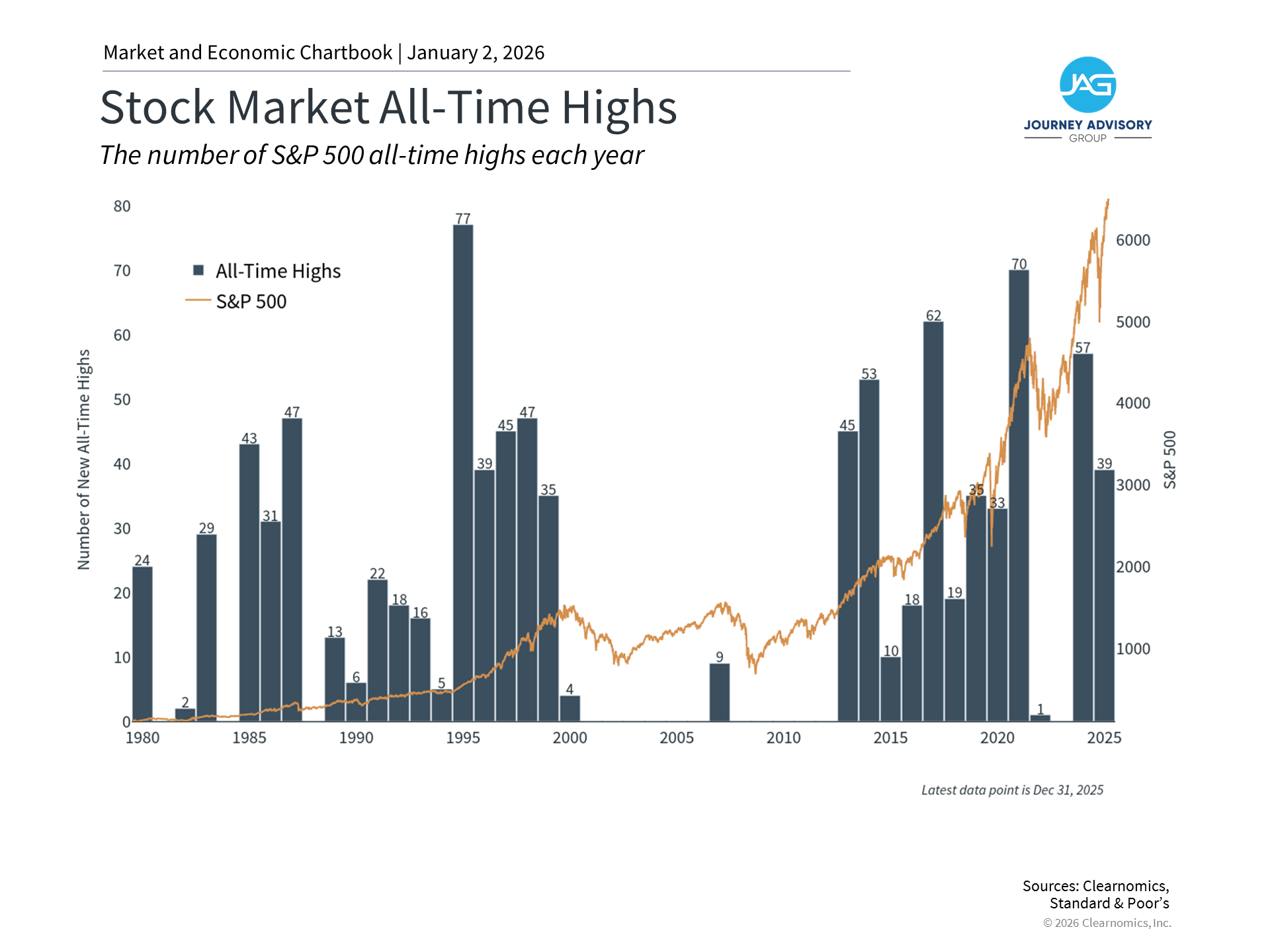
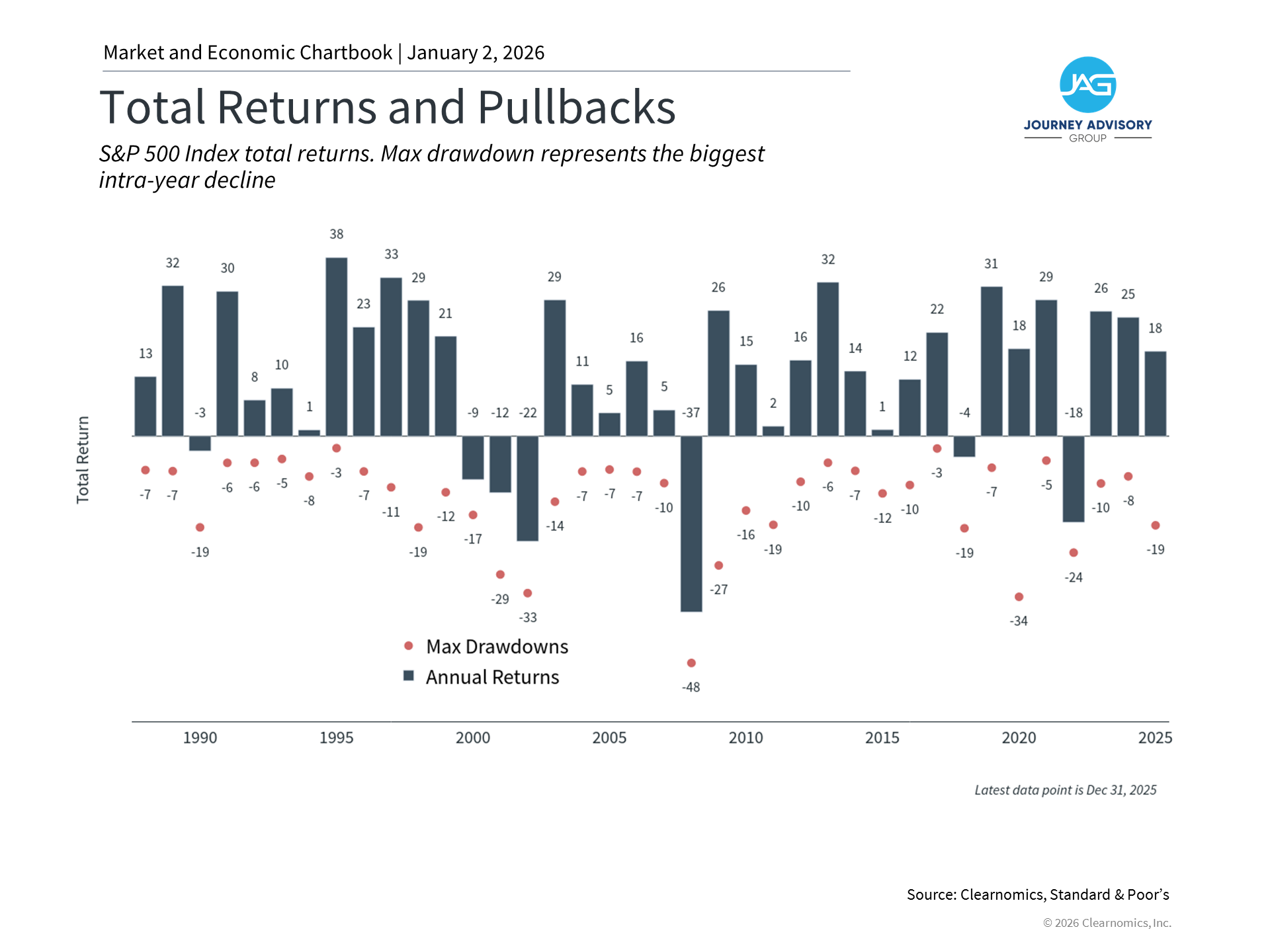
The year 2025 was very strong for the stock market, even though many important events happened during the year. There were many news stories including tariff announcements in April, changes in artificial intelligence (AI) company stocks, the passing of the One Big Beautiful Bill Act, and more. Despite all of this, investors likely ended the year happy. U.S. stocks reached new record highs, international markets (stocks from other countries) did better than expected, and bonds (loans to companies or governments) bounced back. The S&P 500 (a measure of 500 large U.S. companies) has now delivered returns above 10% in six of the past seven years. It has almost doubled in value since hitting a low point in 2022. This past year shows us an important lesson: the best way to handle uncertainty is to stay disciplined and keep your eyes on your long-term goals. As we move into 2026, it helps to understand what moved markets last year. This knowledge can help investors deal with the challenges and take advantage of opportunities ahead. Important Market and Economic Facts from 2025 • The S&P 500 went up 17.9% (including dividends, which are payments companies make to shareholders) in 2025. It reached 39 new all-time highs during the year. The Dow Jones Industrial Average (another measure of 30 large U.S. companies) rose 14.9% and the Nasdaq (which includes many technology companies) returned 21.2%. • The VIX (a measure of how much the stock market is expected to move up and down) remains low compared to history. It finished at 14.95 after climbing as high as 52.33 in April. • The Bloomberg U.S. Aggregate Bond Index (a measure of the overall bond market) gained 7.3%. This was its best performance since 2020. The 10-year Treasury yield (the interest rate on a 10-year loan to the U.S. government) ended the year lower at 4.17%, down from 4.57% at the start of the year. • International developed markets (stocks from wealthy countries outside the U.S.) and emerging markets (stocks from developing countries) each gained over 30% when measured in U.S. dollars. This is based on the MSCI EAFE Index and MSCI EM Index. • The U.S. dollar index (which measures the dollar's value compared to other currencies) ended the year at 98.32. This was a 9.3% drop from 108.49 at the beginning of the year. The dollar reached a low of 96.63 in September. • Bitcoin went down about 6.5% from $93,714 to $87,647, after rising as high as $125,260 in October. • Gold prices went up throughout the year, finishing at $4,341 per ounce for a 64% gain. Silver prices also rose to $70.60 per ounce from $29.24 at the start of the year. Major events in 2025
Many of the events from last year were things we knew might happen, even if we didn't know exactly when or how. Former Secretary of Defense Donald Rumsfeld called these "known unknowns." He separated them from "unknown unknowns," which are surprises we can't anticipate. For investors, this difference matters because "known unknowns" are uncertainties we can prepare for. When markets react to these events, investors who are prepared don't get caught off guard. For example, concerns about tariffs (fees on imported goods) were already on investors' minds before April 2. While this didn't stop the market from reacting to the size of these tariffs, it did help the market recover quickly once things settled down. Investors also knew the Federal Reserve (the Fed, which is the U.S. central bank) would likely change interest rates once the job market weakened. Many also expected a new tax bill to pass since Republicans controlled both houses of Congress. Even concerns about AI, which may be the biggest uncertainty for markets today, have been on investors' minds. The DeepSeek moment in January was unexpected. This happened when a Chinese AI company showed that AI models could be created and run more cheaply than people thought. However, investors understand the similarities to the dot-com boom (when internet stocks soared in the late 1990s) and past periods when large companies spent heavily on technology.
To sum up the major events that moved markets over the year, here are the top 10: • January 20: President Trump is inaugurated. • January 21: The $500 billion private-sector Stargate project is announced. • January 27: AI stocks fall on DeepSeek news. • April 2 to 9: "Liberation Day" tariff announcement leads to a market correction (when stock prices fall). This was followed by a 90-day pause which sparked a rally (when stock prices rise). • July 4: The "One Big Beautiful Bill Act" is signed into law, extending many Tax Cuts and Jobs Act provisions. • September 17: The Fed begins cutting interest rates again. • September 22: Nvidia and OpenAI announced a major strategic partnership and investment, raising concerns of "circular deals." • October 1: The government shuts down for what would be a record-setting 43 days. • October 14: Jamie Dimon warns of "cockroaches" after the bankruptcies of Tricolor and First Brands. • December 16: According to the BEA (Bureau of Economic Analysis), the unemployment rate hit a four-year high of 4.6% in November. Three key themes defined the past year
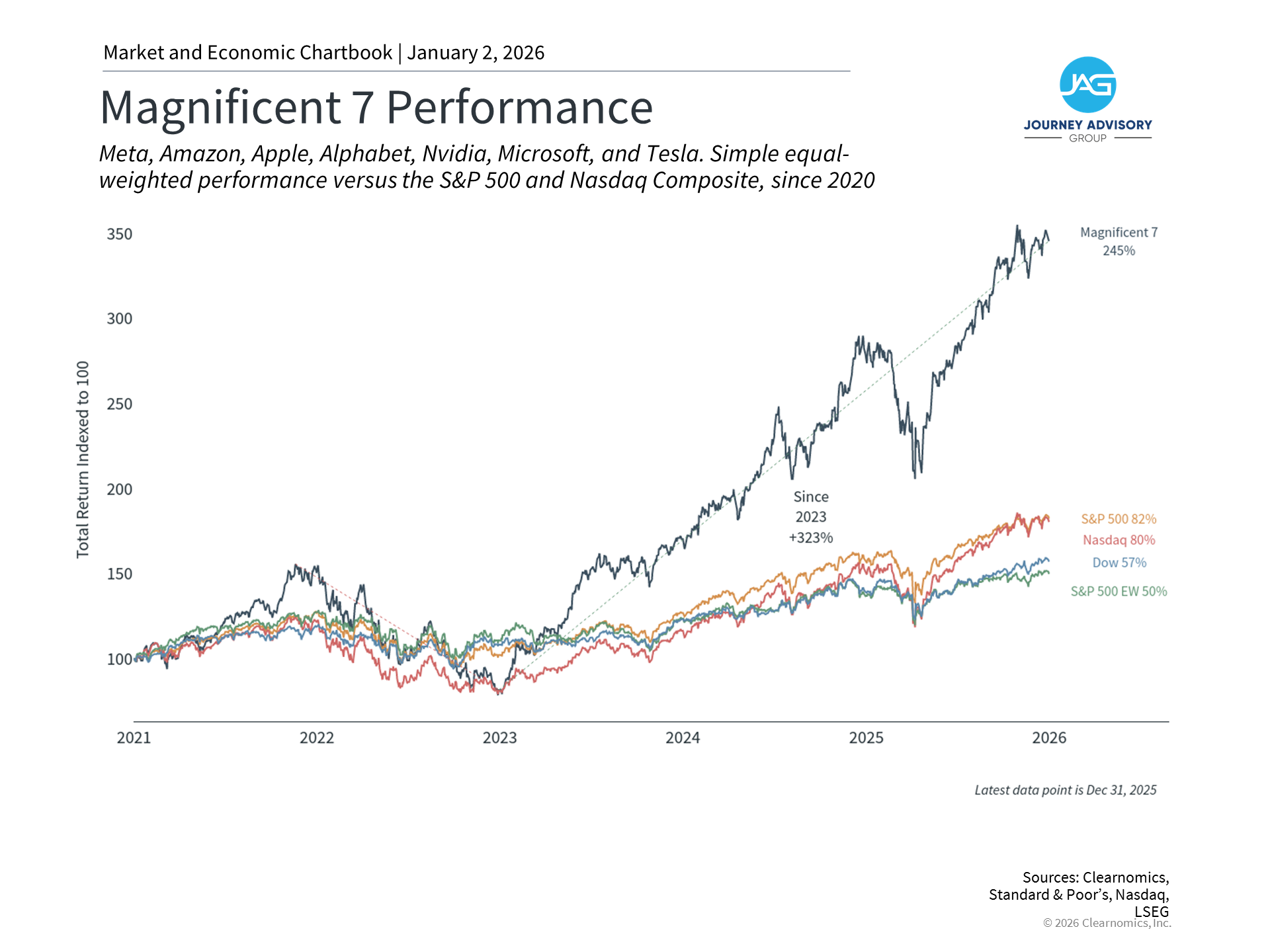
What themes drove markets across these events? First, it's hard to miss that artificial intelligence was a major focus throughout 2025. From large investments in AI infrastructure (the technology systems needed to support AI) to concerns about market concentration (when a few companies make up a large portion of the market), AI became an important source of economic growth and market returns. The Magnificent 7 stocks (seven large technology companies) now represent around one-third of the S&P 500. This creates concentration risk, which means most investors have exposure to these stocks whether they realize it or not. Understanding this when building investment strategies and financial plans will only become more important. Second, tariff policy created uncertainty but has had less economic impact than expected. Tariffs on imported goods have risen sharply for many trading partners. However, the feared economic consequences largely didn't happen. This is because companies adapted, tariffs were paused or reduced, and consumer spending remained strong. For investors, this shows that the outcomes of policy changes in Washington do not always have an obvious effect on the economy or markets, whether those changes involve trade or federal finances. Third, many types of investments performed well in 2025. International stocks did better than U.S. markets, partly because the U.S. dollar declined in value. Bonds generated strong returns and have nearly recovered their losses from 2022. Other individual investments including gold also had record years. So, benefiting from all of these investment types is less about picking individual investments. It's more about having the right mix of different investments (called asset allocation) that can take advantage of opportunities while managing sources of risk. The bottom line? The year 2025 was strong for investors. While we celebrate a good year in markets, it reminds us how important it is to stay disciplined with our investments. Investors should continue to apply this lesson to their investment and financial plans for the coming year. | |||
Disclosures This material prepared by Journey Advisory Group is for informational purposes only. It is not intended to serve as a substitute for personalized investment advice or as a recommendation or solicitation of any particular security, strategy or investment product. Economies and markets fluctuate. Facts presented have been obtained from sources believed to be reliable. Journey Advisory Group, however, cannot guarantee the accuracy or completeness of such information, and certain information may have been condensed or summarized from its original source. Past performance is not an indicator of future results.Copyright (c) 2026 Clearnomics, Inc. All rights reserved. The information contained herein has been obtained from sources believed to be reliable, but is not necessarily complete and its accuracy cannot be guaranteed. No representation or warranty, express or implied, is made as to the fairness, accuracy, completeness, or correctness of the information and opinions contained herein. The views and the other information provided are subject to change without notice. All reports posted on or via www.clearnomics.com or any affiliated websites, applications, or services are issued without regard to the specific investment objectives, financial situation, or particular needs of any specific recipient and are not to be construed as a solicitation or an offer to buy or sell any securities or related financial instruments. Past performance is not necessarily a guide to future results. Company fundamentals and earnings may be mentioned occasionally, but should not be construed as a recommendation to buy, sell, or hold the company's stock. Predictions, forecasts, and estimates for any and all markets should not be construed as recommendations to buy, sell, or hold any security--including mutual funds, futures contracts, and exchange traded funds, or any similar instruments. The text, images, and other materials contained or displayed in this report are proprietary to Clearnomics, Inc. and constitute valuable intellectual property. All unauthorized reproduction or other use of material from Clearnomics, Inc. shall be deemed willful infringement(s) of this copyright and other proprietary and intellectual property rights, including but not limited to, rights of privacy. Clearnomics, Inc. expressly reserves all rights in connection with its intellectual property, including without limitation the right to block the transfer of its products and services and/or to track usage thereof, through electronic tracking technology, and all other lawful means, now known or hereafter devised. Clearnomics, Inc. reserves the right, without further notice, to pursue to the fullest extent allowed by the law any and all criminal and civil remedies for the violation of its rights. |

Looking Back at 2025: A Strong Year for the Stock Market