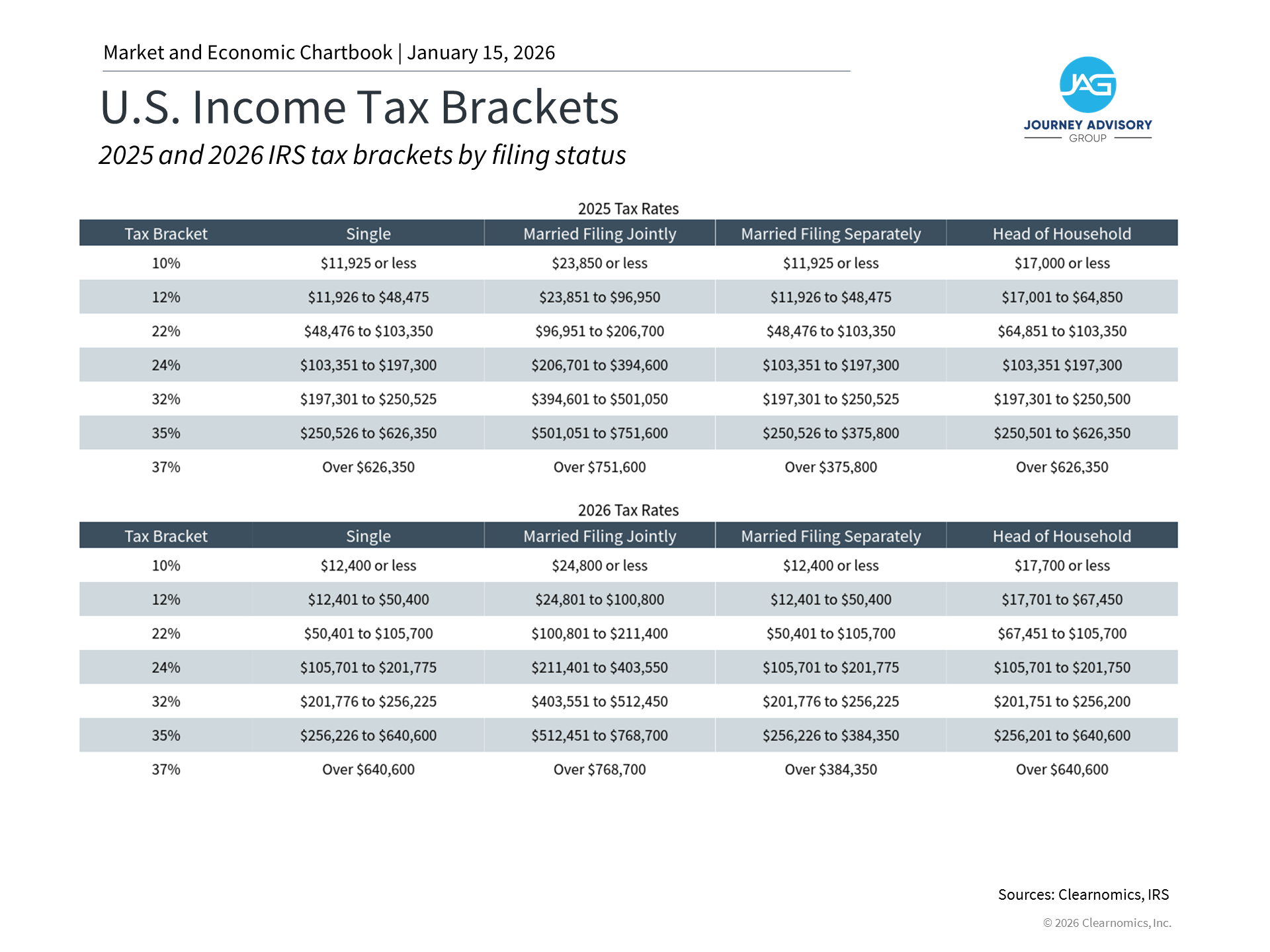
Tax rules are changing in 2026, and these changes could affect how you save and plan for the future. Some changes limit how you can save for retirement, while others may help you pay less in taxes. Understanding these updates can help you make better choices with your money this year. These changes matter most if you earn a higher income or are over 50 years old. Instead of worrying about each change separately, think of them as chances to improve your financial plan. New rules for extra retirement savings
A big change affects people age 50 and older who save extra money for retirement (called "catch-up contributions"). In the past, you could choose to put this extra money in before taxes are taken out, which lowered your tax bill today. Starting in 2026, if you earn $150,000 or more per year, you must put these extra savings into a Roth account instead. With a Roth account, taxes are taken out now, but your money grows tax-free and you won't pay taxes when you take it out in retirement. The amount you can save has gone up slightly to $8,000 for those 50 and older. If you're between 60 and 63, you can save even more: $11,250. This change means high earners won't get the immediate tax break they used to get from these extra contributions. Higher limits for state and local tax deductions There's good news too. The limit on how much you can deduct for state and local taxes has increased significantly. This deduction (called SALT) lets you reduce your federal taxes by the amount you pay in state and local taxes. Since 2017, this was capped at $10,000. Now it's been raised to $40,400 for 2026 and will increase by 1% each year through 2029. This helps many people, especially those living in states with higher taxes like California, New York, and New Jersey. It may also make sense for more people to itemize their deductions instead of taking the standard deduction. When you itemize, you add up specific expenses like mortgage interest, charitable donations, and state taxes to reduce your taxable income. The standard deduction for 2026 is $16,100 for single people and $32,200 for married couples. Here's an example: A married couple in California pays $35,000 in state taxes, gives $8,000 to charity, and pays $12,000 in mortgage interest. Under the old rules, they could only deduct $10,000 of their state taxes, making their total itemized deductions $30,000—less than the standard deduction. Now they can deduct all $35,000 in state taxes, bringing their total to $55,000, which means they pay less in federal taxes. What this means for your overall plan These tax changes don't exist in isolation—they can affect other parts of your finances. For example, if you're receiving Social Security, any changes that increase your income could make more of your Social Security benefits taxable. The rules for how much of your Social Security is taxed haven't changed in many years, so even small income increases can matter. There's also a new "senior bonus" deduction available from 2025 to 2028 for people 65 and older. This gives you an extra $6,000 deduction if you're single or $12,000 if you're married. However, this phases out if your income is too high. Remember that the higher SALT deduction limit is temporary and will go back to $10,000 in 2030, so you have a limited time to benefit from it. The bottom line? Tax rules in 2026 are complicated and affect everyone differently. Looking at how all these changes work together, rather than separately, can help you make better financial decisions. References 1. https://taxpolicycenter.org/briefing-book/what-are-itemized-deductions-and-who-claims-them | |
This material prepared by Journey Advisory Group is for informational purposes only. It is not intended to serve as a substitute for personalized investment advice or as a recommendation or solicitation of any particular security, strategy or investment product. Economies and markets fluctuate. Facts presented have been obtained from sources believed to be reliable. Journey Advisory Group, however, cannot guarantee the accuracy or completeness of such information, and certain information may have been condensed or summarized from its original source. Past performance is not an indicator of future results.Copyright (c) 2026 Clearnomics, Inc. All rights reserved. The information contained herein has been obtained from sources believed to be reliable, but is not necessarily complete and its accuracy cannot be guaranteed. No representation or warranty, express or implied, is made as to the fairness, accuracy, completeness, or correctness of the information and opinions contained herein. The views and the other information provided are subject to change without notice. All reports posted on or via www.clearnomics.com or any affiliated websites, applications, or services are issued without regard to the specific investment objectives, financial situation, or particular needs of any specific recipient and are not to be construed as a solicitation or an offer to buy or sell any securities or related financial instruments. Past performance is not necessarily a guide to future results. Company fundamentals and earnings may be mentioned occasionally, but should not be construed as a recommendation to buy, sell, or hold the company's stock. Predictions, forecasts, and estimates for any and all markets should not be construed as recommendations to buy, sell, or hold any security--including mutual funds, futures contracts, and exchange traded funds, or any similar instruments. The text, images, and other materials contained or displayed in this report are proprietary to Clearnomics, Inc. and constitute valuable intellectual property. All unauthorized reproduction or other use of material from Clearnomics, Inc. shall be deemed willful infringement(s) of this copyright and other proprietary and intellectual property rights, including but not limited to, rights of privacy. Clearnomics, Inc. expressly reserves all rights in connection with its intellectual property, including without limitation the right to block the transfer of its products and services and/or to track usage thereof, through electronic tracking technology, and all other lawful means, now known or hereafter devised. Clearnomics, Inc. reserves the right, without further notice, to pursue to the fullest extent allowed by the law any and all criminal and civil remedies for the violation of its rights.  |

How New Tax Changes May Affect Your Money in 2026